Process & contact
Mecana AG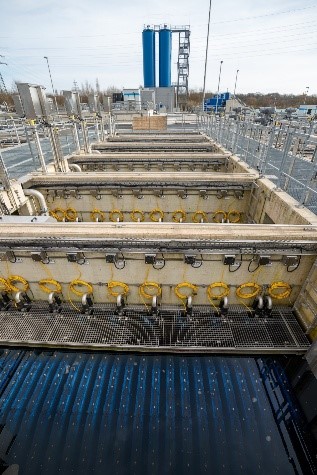
Contact(s):
Updated 04/2026
Types of wastewater treated - Input flows – Implementation in sewage works
Pile Cloth Media Filtration (PCMF) is primarily used for municipal and industrial wastewater treatment and is widely applied as a primary, tertiary, or polishing step. The technology can also be applied to side streams, such as digester filtrate, after appropriate pre-treatment; however, it is not suitable for raw manure or sludge.
The required effluent quality can be achieved using standard, microfiber, or ultrafiber PCM, depending on water characteristics and requirements for the filtrate.
It is compatible with activated sludge systems, trickling filters, sequencing batch reactors (SBR), enhanced biological phosphorus removal (EBPR), and chemical phosphorus removal systems.
When used in tertiary or quaternary treatment stages, PCMF removes suspended solids (typically down to < 2–3 mg/l) and is highly effective in removing particulate phosphorus (< 0.05 mg/l). Dissolved phosphorus can also be removed when iron or aluminum salts are dosed upstream to precipitate phosphate.
Reagents – Energy - Output materials
The technique is purely physical and does not require any additives.
For enhanced phosphorus removal, iron or aluminum salts may be added upstream. Polymers can optionally be used to improve floc formation. The system is fully compatible with chemical phosphorus precipitation.
Specific energy consumption typically ranges from 4–25 Wh per m³ treated, depending on influent concentrations and plant configuration.
The removed phosphorus is contained in the backwash water and becomes part of the sludge stream. The solids content is typically 0.8–2 g/L, corresponding to approximately 0.08–0.2% dry solids. The phosphorus content of the dry matter typically ranges from 3–8% (as P), depending on chemical dosing. The organic content is comparable to that of municipal sludge, and iron or aluminum concentrations increase when chemical precipitation is applied.
Process description – Phosphorus removal
PCM is a woven cloth with a multidimensional structure, consisting of a filter-active pile layer and a non-filter-active backing.
Wastewater flows into a filter tank containing filter discs equipped with PCM. Filtration occurs through the PCM, with suspended solids retained within the pile layer. As solids accumulate, headloss increases, and an automatic backwash system cleans the PCM while filtration continues uninterrupted. The backwash water is returned to the sludge line.
Phosphorus removal occurs through the retention of particulate phosphorus and if chemicals applied, chemically precipitated phosphorus. The process removes other contaminants to the extent that they are particle-bound.
With upstream chemical precipitation, effluent concentrations of ≤ 0.1 mg P/L are typically achievable, depending on the selected media type, e.g., ultrafiber PCM (OptiFiber UF-10) or microfiber PCM (OptiFiber PES-14).
Operating status
PCMF has been implemented in several thousand full-scale installations worldwide for municipal and industrial applications. Plant capacities range from small facilities (<5,000 population equivalents) to large plants (>1,000,000 population equivalents). Individual units can treat several hundred up to more than 1,000 m³/h and are fully modular and scalable. The technology has been in full-scale operation since the 1990s, with many installations operating reliably for more than 20 years