Process & contact
Suez
Website: www.suez.com
Contact(s):
Updated 09/2026
Types of wastewater treated - Input flows – Implementation in sewage works
Pumpable sewage sludge (containing phosphate)
Reagents – Energy - Output materials
Dewatered phosphate solids, with or without brine. The process is still under development to align with the specifications for application(s).
Process description – Phosphorus removal
The SUEZ hydrothermal gasification process is based on the gasification of sewage sludge in supercritical water (above 374°C and 221 bar).
Under these conditions, water exhibits unique physicochemical properties: many inorganic salts become insoluble, while water itself becomes a highly reactive medium that promotes radical reactions. As a result, the organic matter is converted into a methane-rich gas with a composition comparable to natural gas. This mimics, in an accelerated way, the natural geological process by which organic matter is transformed into natural gas over millions of years.
The nitrogen contained in the organic matter is transferred to the liquid phase, where it can be recovered and potentially reused.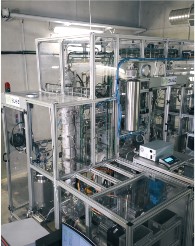
Most mineral compounds, which are normally soluble in water, become insoluble under supercritical conditions. In particular, phosphorus precipitates and can be recovered. Silica (sand), iron oxides, aluminium oxides and calcium compounds are also concentrated in the resulting mineral brine.
The downstream separation of phosphorus from the other minerals in this brine, as well as the control of its chemical speciation, is still under development to align with the envisaged applications (chemical form and purity).
Operating status
TRL 7 for Hydrothermal gasification. We have performed > 100 continuous laboratory trials. An industrial prototype is under construction for operability tests at Terres d’Aquitaine (Suez Organique), Gironde.
TRL 6 for phosphate recovery and upgrading to current standards, at GH LAB: CIRSEE, Croissy-sur-Seine (photo).