Newsletter about nutrient stewardship - European Sustainable Phosphorus Platform (ESPP)
Please subscribe www.phosphorusplatform.eu/Subscribe
Link to www.phosphorusplatform.eu/eNews105
Download as PDF
Help ESPP continue sharing free information on phosphorus sustainability! DONATE NOW.
Events
18th CRU Phosphates & Potash 2026, Paris, 13-15 April 2026
16th April 16h00-17h30 CET (online): climate emissions from phosphate fertiliser use
ESNI-NERM 2026: the flagship event on nutrient research, Brussels, 28-29 April 2026
Implementation of EU UWWTD art. 20 P reuse and recycling rates, Madrid 8-9 June
6th European Sustainable Phosphorus Conference ESPC6 24-26 November 2026, Benguerir, Morocco
ESPP new member
Pazul integrated real-time nutrient monitoring solutions for wastewater and industry
Bringing nutrient management into R&D projects
ESPP and National Nutrient Platforms can bring value to R&D projects
Policy
Joint industry call for the EU FPR to enable innovation, circularity, bioeconomy
US Presidential order on strategic supply of Elemental Phosphorus
Very slow progress towards maybe authorising some additional materials under the FPR
Nutrient recycling and nutrient management
German Minister confirms that P-recovery deadline dates will not be extended
First Belgian EU FPR Certification for Organic Fertilisers
DPP visit to Seraplant ash processing plant, Haldensleben
Implications of the revised UWWTD for sewage treatment infrastructure in Poland
Fertilisers, soil, eutrophication and climate
Long-term use of mineral fertiliser results in higher soil organic carbon
Sub-basin scale phosphorus planetary boundaries in China
Global phosphorus losses to oceans continue to increase
Chesapeake nutrient management could bring US$ 6 million/year GHG benefits
Methane from waters and wetlands are > 1/3 of global emissions, and rising
ESPP Members
Stay informed
Events
18th CRU Phosphates & Potash 2026, Paris, 13-15 April 2026
 The annual world P and K industry & technology meeting place, covering the whole industry value chain: mining and resources, beneficiation, fertilisers – feed and industrial applications, environmental aspects of production management, sustainability.
18th CRU Phosphates & Potash 2026, Paris (Paris Marriott Rive Gauche Hotel), 13-15 April 2026 http://events.crugroup.com/phosphates/home
Conference discount code available on request from ESPP for ESPP members.
16th April 16h00-17h30 CET (online): climate emissions from phosphate fertiliser use
 How does use of P fertilisers in the field impact climate emissions, e.g. via eutrophication effects or mitigation, crop carbon and soil carbon cycling. Online workshop will input to the Low Carbon Roadmap for the phosphate industry
Online workshop, 16th April 16h00 - 17h30 CET. Programme and registration here.
ESNI-NERM 2026: the flagship event on nutrient research, Brussels, 28-29 April 2026
 ESNI-NERM is the joint European conference on nutrient research, organised by the Biorefine Cluster and ESPP, addressing the scientific issues, developments and challenges of nutrient management and nutrient recycling.
Registration now open. NERM-ESNI Tue. 28th April 2026 12h00 – Wed. 29th April 16h30 https://www.biorefine.eu/esni-nerm-2026/
Implementation of EU UWWTD art. 20 P reuse and recycling rates, Madrid 8-9 June
 ESPP workshop to input to the development of proposals for phosphorus “reuse and recycling rates” from sewage, update on P-recover, with participation of the European Commission Joint Research Centre (JRC).
This workshop will enable direct dialogue between phosphorus recycling technology suppliers, wastewater operators, fertiliser companies and regulators working on defining the implementing criteria for the Urban Waste Water Treatment Directive nutrient removal and (art. 20) phosphorus “reuse and recycling rates”:
- EU policy context and UWWTD art. 20 implementation work ongoing: European Commission JRC
- Spain policy context: Spanish Ministry for Ecological Transition and the Demographic
- Challenge
- Are “Quotas” an appropriate policy tool ? (recycled phosphorus content obligations for fertilisers)
- Sewage sludge incineration and alternative thermal processes: costs, logistics, energy recovery, phosphorus recovery
- Sewage biosolids valorisation to agriculture
- Digestion processes to release soluble P from sewage for higher recovery rates
To present an update on your recycling technology or to speak at this workshop, contact
Workshop on phosphorus reuse and recycling from urban wastewater, Madrid, Monday 8th June 14h00 – Tuesday 9th June 12h30. More information here.
6th European Sustainable Phosphorus Conference ESPC6: 24-26 November 2026, Benguerir, Morocco
www.phosphorusplatform.eu/ESPC6
 ESPC is the world’s leading sustainable phosphorus event, every 2-3 years. Don’t miss it! ESPC6 will include a site visit to an OCP phosphate mine, rock beneficiation and processing.
ESPC6 is co-organised by OCP Group and ESPP, with support of UM6P (Université Mohammed VI Polytechnique).
The event will take place UM6P Université Mohammed VI Polytechnique, in Benguerir, 1 hour shuttle from Marrakech, with accommodation in Ben Guerir or Marakkech.
ESPC6 will address:
- Fertilisers, P-stewardship and their role in supporting sustainable food systems and food security
- Interactions between climate change and phosphorus, including impacts on P dynamics, carbon sequestration, soil fertility, crop productivity, and nutrient requirements
- P-recovery and recycling
- P-removal
- Sustainability in P mining and processing
- Other aspects of P chemistry, P management, and P different uses.
In addition to site visit, side events may include a Young Nutrient Researchers Day.
Deadline for abstracts to main sessions 30th April 2026. Proposals for side events are welcome to
ESPP new member
Pazul integrated real-time nutrient monitoring solutions for wastewater and industry
 Pazul Ltd is a Cranfield University, UK, spin-out developing real-time monitoring solutions with proprietary sensor technology and integrated data tools, for wastewater management and complex aquatic pollution problems. Pazul technology helps utilities and industry measure water quality in real time and act on the results. Our first product focus is phosphate: an electrochemical sensor platform based on molecularly imprinted polymers (MIPs) that delivers rapid, low-maintenance measurements in minutes, without wet-chemistry reagents or sample preparation. We are developing this platform for municipal and industrial wastewater treatment plants to support day-to-day process optimisation: improving control of phosphorus removal and enabling more efficient operation and, where relevant, phosphorus recovery. Continuous phosphate intelligence can reduce chemical use, emissions and operational costs while maintaining stable treatment performance and protecting receiving waters. Alongside the hardware, we are building data tools for natural and engineered systems to turn continuous monitoring into actionable insights. We are joining ESPP to connect with the wider phosphorus management and circular-economy community, share practical learning from treatment environments, and collaborate on solutions that improve overall nutrient management and improve water quality.
Website: https://pazul.co.uk/
Bringing nutrient management into R&D projects
ESPP and National Nutrient Platforms can bring value to R&D projects
ESPP and the national Nutrient Platforms can connect your research project to the entire European agriculture and industry value chain, providing the global reach and stakeholder access necessary for success. Through our extensive network, we enable projects to establish direct contact with companies, regulators, R&D institutions, and agricultural and environmental stakeholders. The European Sustainable Phosphorus Platform (ESPP) serves as the umbrella for this initiative, collaborating with the Dutch, German, Swedish, Italian, and Catalan Nutrient Platforms. Together we bring strategic value for your project:
- Communication & Dissemination: Our platforms can lead or support your project’s outreach strategy. Through our established channels, newsletters, and international events, we provide a pre-existing audience for immediate dissemination and exploitation of results. This includes ESPP’s global 116 000 targeted emailing list, eNews and SCOPE Newsletter.
- Coordinated Multi-Actor Approach: We bridge the gap between research and practice. By involving our regional Platforms, your project gains direct access to industry across Europe, including fertiliser producers, chemicals, waste management, water treatment, technology providers.
- Translation to Policy & Market: Through ten years of close contacts with regulators and participation in policy and regulatory advisory structures, we can help bring research and technical innovation into evidence-based policy briefs and market-ready insights, ensuring that your project outcomes resonate with European and national decision-makers.
Our Platforms can bring expertise to R&D project consortia on:
- Nutrient flows
- Nutrients and the bioeconomy: feeding biomass production, recycling from bioeconomy processes
- Standards development to support nutrient recycling and bio-based products
- Boi-based innovation
- Nutrient governance, knowledge sharing and networking
- Agriculture and eutrophication, Best Agriculture Environmental Practice for nutrient management
We are looking to join consortia for calls in Horizon Europe Cluster 6, the EU Soil Mission, Circular Bio-based Europe (CBE), Interreg, LIFE or other EU or national projects.
To bring the Nutrient Platforms into your project consortium, or to engage our input, support and dissemination tools for your project, contact
Policy
Joint industry call for the EU FPR to enable innovation, circularity, bioeconomy
ESPP and eight fertilising product federations’ joint statement to the Evaluation of the EU Fertilising Products Regulation (FPR) calls for a criteria-based approach to enable inclusion of new materials into the Regulation. The organisations consider that the current exclusion of widely and safely used materials and the absence of a mechanism to allow timely updating of the list of eligible materials (CMCs) is resulting in very low uptake of the FPR CE-Mark: <5% of Organic and Organo-Mineral Fertilisers and <1% of Growing Media on the EU market today. The FPR is not responsive to innovation and to developments in recycling and in the bioeconomy, so is not delivering its objectives of Circular Economy and harmonisation of EU market access. This is detrimental to the bioeconomy, recycling, EU industry and to farmers. ESPP and the industry federations call for the current official Evaluation to recognise this structural problem in the FPR and to be followed by a legislative proposal to address this. Together, we suggest the inclusion into Annex II (CMCs) of evidence-based criteria to determine the eligibility of new materials and processes, in order to enable transparent, efficient, robust and timely assessment.
The industry federations concerned representing the fertilisers value chain, with ESPP, have launched a Joint Task Force to continue to proactively and constructively push to adapt the EU Fertilising Products Regulation to innovation, circularity and the bioeconomy.
“Addressing structural barriers to innovation, circularity, and market access in the EU Fertilising Products Regulation (EU) 2019/1009”, Joint Statement, 10th February 2026, European Consortium of the Organic-Based Fertilizer Industry (ECOFI), European Biostimulants Industry Council (EBIC), European Compost Network (ECN), European Sustainable Phosphorus Platform (ESPP), EUROFEMA, Growing Media Europe, Fertilizers Europe, European Potash Producers Association (APEP), European Biogas Association (EBA). www.phosphorusplatform.eu/regulatory
EU fertilising products industry Joint Task Force https://ecofi.info/addressing-structural-barries-to-innovation-circularity-and-market-access-in-the-eu-fertilising-products-regulation/
US Presidential order on strategic supply of Elemental Phosphorus
Order published 18th February says ‘Elemental Phosphorus’ is “critical to national defense and security”, for military applications, electronics and batteries, and calls for federal action to ensure adequate domestic supply. The Order correctly identifies elemental phosphorus (presumably meaning P4) as a key input for military smoke, illumination and incendiary devices, for defence technologies such as radar, solar cells, sensors and optoelectronics, and for batteries and semiconductors. The Presidential Order also states that elemental phosphorus (that is, P4) is a necessary precursor for the herbicide glyphosate, which it states is critical for US farmers to produce food and animal feed “efficiently and cost-effectively”.
The Order correctly states that there is today only one producer of P4 in the US and that the US imports 6 kt/y of P4 but confusingly refers to “elemental phosphorus mining”.
ESPP notes:
P4 does not occur in nature and cannot be mined. P4 is manufactured from mined phosphate rock in dedicated furnaces and there are today only four countries worldwide with significant P4 production: China, Vietnam, Kazakhstan, USA. The EU has no P4 production and is today totally dependent on imports.
The 6 ktP/y US P4 imports stated in the Order is <1% of world P4 production and maybe around 10% of US P4 use. Because the EU has no P4 production, EU imports are 10 – 20 times this tonnage.
Only around 4% of mined phosphate rock worldwide goes to P4, whereas over 90% of mined phosphate rock is used for food production via fertilisers or animal feed phosphates (not via P4). Phosphate rock (not P4) is on the EU Critical Raw Materials List because it is essential for agriculture and food security.
ESPP also notes that this Order does not cite a number of other strategic applications where P4 derived chemicals are essential: fire safety (of cables, electronics, transport, wood …), hydraulic control liquids for machines and aviation, catalysts, crude oil drilling and extraction, pharmaceuticals …
“Promoting the national defense by ensuring an adequate supply of elemental phosphorus and glyphosate-based herbicides”, US Presidential Executive Order, 18th February 2026 https://www.whitehouse.gov/presidential-actions/2026/02/promoting-the-national-defense-by-ensuring-an-adequate-supply-of-elemental-phosphorus-and-glyphosate-based-herbicides/
Very slow progress towards maybe authorising some additional materials under the FPR
Some progress seems to be made towards authorising 13 additional input materials into FPR CMCs, but as many others are rejected, mainly for “inadequate data”. And most Animal By-Products are still not integrated into CMC10.
Three and a half years after the European Commission survey identifying materials currently excluded from the FPR, the draft second report from NMI (commissioned by the Commission) begins to outline possible criteria for inclusion of a few materials (paper industry lime, recovered Mn and Zn from battery recycling, certain food and feed industry residues, certain wood and plant derived materials, wider definition of combustion for ashes). But a significant number of other proposed materials, including various nutrient recycling products, are evaluated negatively, often because of “inadequate data”. This includes materials for which there have been several or many EU-funded R&D projects. ESPP asks: why spend taxpayers’ money if these projects do not produce the needed data ? Materials currently proposed for rejection include ammonium and phosphate salts from end-of-life fire extinguishers (see ESPP eNews n°97), vivianite from sewage, sewage sludge biochars, source-separated human urine products, plant or algae biomass grown in sewage treatment. Biorefinery residues as inputs to digestates are still not evaluated despite being submitted in 2022. ESPP has made detailed input on the 160-page NMI report, including information collated from a number of competent stakeholder organisations and experts, lists of studies submitted to NMI which seem not to have been taken into account, and precise proposals for CMC wordings for a number of materials.
The fact that, to date, none of the materials submitted by stakeholders to the Commission’s 2022 survey have yet been validated for inclusion into the FPR, shows that the process is broken. There are today no criteria as to what data is needed, no transparency of evaluation, no timeline, and the result is considerable industry and stakeholder frustration, with rejection of innovative nutrient recycling routes, and with market-ready companies having no choice but country-by-country national fertilisers rules.
See summary of NMI’s first report in ESPP eNews n°100.
Concerning Animal By-Products in the FPR, these are today authorised as inputs to composts and digestates and ash-based fertilisers (under specified conditions), and “Processed Manure” is authorised under CMC10 (see ESPP eNews n°89). However, other ABPs are still pending, despite conclusion of the QLab report May 2025, which proposed conditions for inclusion of around ten different ABPs into CMC10. This delay seems to be partly due to disagreements about limits for chromium and arsenic in ABPs from leather processing (see ESPP eNews n°89).
Nutrient recycling and nutrient management
German Minister confirms that P-recovery deadline dates will not be extended
Germany’s Federal Environment Minister has sent a written reply to stakeholders, including DPP, stating that the deadlines for implementing phosphorus recovery from sewage will not be postponed. The German Association for Water, Wastewater and Waste (DWA) wrote formally to the Minister in December 2025 requesting to push back the 2029 deadline for implementation of P-recovery in many German sewage works (see detail in ESPP eNews n°104). ESPP, the German Phosphorus Platform (DPP) and other stakeholders, wrote to the Minister indicating that several full-scale P-recovery plants are already operational in Germany or under construction and will be operational by the 2029 deadline, that postponing deadlines will result in postponement of investment decisions and of roll-out of these or other technologies, and that recovered phosphorus products already today have a market when of appropriate quality. The German Federal Minister underlines that Phosphate Rock is an EU Critical Raw Material and that P-recovery from sewage can make a significant contribution to sustainability and to reducing EU dependency on imports. The Ministry states that postponing the legal deadline for P-recovery implementation fixed by German legislation would exacerbate obstacles and deprive the industry of planning certainty and incentives for technological development and investment decisions. The Minister confirms that a ‘fund mechanism’ will be developed whereby water operators not achieving P-recovery by the Regulation deadline would pay into a fund to finance P-recovery investments by operators moving ahead. The Ministry expresses thanks for the German Phosphorus Platform (DPP) support and constructive participation.
DPP (German Phosphorus Platform) position, 20th January 2026, “No deadline extension – create a transitional solution”: https://www.deutsche-phosphor-plattform.de/dpp-fordert-umsetzung-der-phosphorrueckgewinnungspflicht-ab-2029-keine-fristverschiebung/
ESPP letter to the German Environment Minister www.phosphorusplatform.eu/regulatory
First Belgian EU FPR Certification for Organic Fertilisers
DCM obtains EU Fertilising Products Regulation Certification for solid and liquid organic and organo-mineral fertilisers containing recycled nutrients (Module D1 CE-Mark FPR Certification). De Ceuster Meststoffen NV (DCM) is the first company in Belgium to obtain FPR Certification for a recycled nutrient product. The Certification means that the products can be freely transported to and sold in any EU country. The CE-Mark, obtained after audit of production at DCM’s Grobbendonk site, is a guarantee of quality and safety. DCM states that the Certification is part of the company’s commitment to sustainable, innovative and high-quality plant nutrition solutions for agriculture, professional horticulture and home gardening.
“DCM, first Belgian producer with European D1 certification for organic fertilisers”, DCM, 30th January 2026 https://www.linkedin.com/posts/de-ceuster-meststoffen_dcm-dcmorganic-moduled1-activity-7422950804824838144-YfQo
DPP visit to Seraplant ash processing plant, Haldensleben
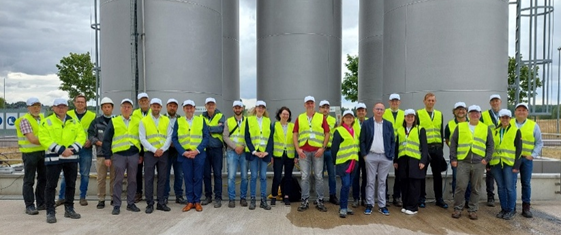 Relaunched after bankruptcy, the Seraplant site has capacity to process 26 000 t/y of sewage sludge incineration ash by reaction with phosphoric acid then granulation. Developed with Glatt Ingenieurtechnik, the plant is currently taking 10-12 different sewage sludge incineration ashes from mono-incinerators within a 50 km distance. The ash is combined with phosphoric acid (2:1 ratio, dry weight) and/or industrial waste acids, then dried by spray granulation at around 90°C, with dust collected and recycled. This results in a fertiliser product containing 17% P* where the phosphorus is c. 90% NAC-soluble. NAC (neutral ammonium citrate) is the measure of crop P availability used in the EU Fertilising Products Regulation FPR, which requires 75% NAC P-solubility for a material to be considered a phosphate fertiliser. At present heavy metals in the sewage sludge incineration ash remain in the output product, but the company indicates that it is working on a process to remove these upstream in the process. The output product contains c. 3% aluminium (Al) and c. 2.6% iron (Fe). Seraplant indicate that the output material is EU Fertilising Products Regulation compliant but that the CE-Mark certification is “very complex, opaque and expensive”.
* ESPP comment: this calculation seems to be based on taking the “dry weight” of phosphoric acid and a P-content of 10% in sewage sludge ash. If taking the wet weight of 85% phosphoric acid and ash with 8.5% P content, then nearly 2.3x more phosphoric acid would be needed to achieve 17%P in the product (input 1 : 2.27 ash dry weight : wet acid).
Photo: German Phosphorus Platform (DPP) visit to Seraplant 9th July 2025.
“Aus der Reihe „DPP vor Ort“: Bericht zur Besichtigung der Seraplant Phosphorrecyclinganlage in Haldensleben am 09.07.2025”, German Phosphorus Platform (DPP) https://www.deutsche-phosphor-plattform.de/aus-der-reihe-dpp-vor-ort-bericht-zur-besichtigung-der-seraplant-phosphorrecyclinganlage-in-haldensleben/
“Phosphorrückgewinnung: Seraplant setzt Prozess- und Verfahrensoptimierung fort”, EUWID 13th November 2025 https://www.euwid-recycling.de/news/wirtschaft/phosphorrueckgewinnung-seraplant-setzt-prozess-und-verfahrensoptimierung-fort-131125
Implications of the revised UWWTD for sewage treatment infrastructure in Poland
The revised Urban Waste Water Treatment Directive (UWWTD) will require upgrading to improve P-removal for half the urban waste water treatment plants > 10 000 p.e. in the Masovian Voivodship (which has 1/10th of Poland’s uwwtps). The administrative region, which includes Warsaw, covers 11% of Poland’s area and nearly 15% of its population, with over 320 wwtps. 30% of the wwtps > 10 000 p.e. will require upgrading to improve N-removal. This study collated published information on wwtp flows and quality of raw and treated wastewater, then assessed changes expected to result from implementation of the revised UWWTD. Based on literature data, the study estimated that most nitrogen in sewage comes from human excrements (7 – 8 gN/person/day in Thailand, Schouwa et al. 2002, 12 – 14 gN/person/day in Sweden, Tumlin & Mattsson 2013). Phosphorus in sewage is estimated to be around 1.7 gP/person/day (same sources – but see also ESPP SCOPE Newsletters n°s 71 and 103). The current estimated discharge from the Voivodship’s wwtps to the Vistula River (and so to the Baltic) is 170 tP/y and 2460 tN/y. Implementation of the revised UWWTD will require upgrading of P-removal for 49% and of N-removal for 31% of the Voivodship’s 326 wwtps > 10 000 p.e. and is estimated to reduce these discharges by -22% for P and -5% for N. Also, 8 larger wwtps will require additional micropollutant removal. The revised UWWTD will thus require considerable investment in wwtp infrastructure.
“Adapting wastewater infrastructure to the new EU directive: Modernization challenges and environmental benefits – Masovian Voivodship case study”, A. Karczmarczyk et al., Desalination and Water Treatment 323 - 101286, 2025 https://doi.org/10.1016/j.dwt.2025.101286
Fertilisers, soil, eutrophication and climate
Long-term use of mineral fertiliser results in higher soil organic carbon
Rothamsted UK soil samples show +10%, +22% or +28% soil organic carbon after 180 years of mineral P, N or N+P fertiliser application (compared to control – no N or P fertiliser). Rothamsted Broadbank (Hertfordshire, UK) is unique worldwide in having continuing consistent experimental field trials since 1843, with mineral fertiliser application on winter wheat compared to no fertiliser. The experiment only has one plot per treatment, because duplicates were only introduced into experimental methods in the early nineteenth century. 20 soil samples (0 -23 cm, plough depth) x 4 sub-plots were taken for each treatment in May 2022 (320 samples). Compared to no fertiliser, P-only fertilisation soil showed considerably higher microbial biomass and respiration (+20%, +37%), limiting organic carbon accumulation. N+P mineral fertilisation for 180 years showed +28% soil organic carbon (compared to no fertiliser). This paper provides no indication as to whether soil organic carbon is continuing to slowly accumulate with fertiliser application, nor as to whether reducing or stopping fertilisation would cause soil organic carbon to be lost.
“Soil carbon sequestration enhanced by long-term nitrogen and phosphorus fertilization”, S. Tang et al., Nature Geoscience, 18, pages1005–1013, 2025 https://doi.org/10.1038/s41561-025-01789-y
Sub-basin scale phosphorus planetary boundaries in China
Study suggests that livestock is currently responsible for exceeding safe P boundaries by 17 – 68 % and water quality thresholds by 31 – 75 % in 25 sub-basins. Total synthetic fertiliser inputs in China are estimated to have increased from 1.2 to 5.3 MtP/y 1980 – 2017, whereas P inputs to livestock systems increased even more, over 6 x, from 1.1 to 7.1 MtP/y. The main reason is identified as the tripling of livestock numbers, combined with over-fertilisation of crops. The external P inputs to the livestock system (synthetic fertilisers used to grow fodder, mineral animal feed additives and P in imported fodder e.g. soy) represented nearly half of inputs, the remainder coming from recycling, e.g. manure fertilising fodder production. Total P losses from China’s crop + livestock system showed a different trend, with total P losses peaking at 2.6 MtP/y in 2010 then decreasing to1 MtP/y by 2017, largely because of regulation ending direct discharge of manure to water or landfill. From 1980 to 2017, the number of studied sub-basins exceeding ‘loose’ and ‘strict’ Phosphorus Planetary Boundaries of based on global limits of 200 MtP/y and 6 200 MtP/y (to protect surface and coastal waters, see ESPP eNews n°104) increased from 0 and 7 (out of 25) in 1980 to all in both cases in 2017. If Phosphorus Planetary Boundaries were estimated for the sub-basins based on China’s water quality standards Class III (0.2 mgP/l) and Class II (0.1 mgP/), then the number of sub-basins in exceedance increased from 10 and 15 in 1980 to 19 and 23 in 2017. The authors note that these P loss estimates may be underestimated as they do not include significant losses from phosphate rock mining and fertiliser production (over 1 000 MtP/y in China).
“An optimized crop–livestock system can achieve a safe and just planetary boundary for phosphorus at the sub-basin level in China”, L Liu, et al., Nature Food, 5(6), 499-512, 2024 https://doi.org/10.1038/s43016-024-00977-0
Global phosphorus losses to oceans continue to increase
Analysis and modelling of river data suggests that total discharge of phosphorus to seas worldwide has increased by over 6% since 2020 (+3.2% / 10 years), with decreasing flows in the Northern hemisphere and increasing in the South. 420 rivers worldwide with catchments > 20 000 km2 each were modelled, covering a total population over 5 billion. Machine learning was applied to estimated river P discharge to seas from 280 000 in situ total P measurements from 1980 to 2019. Estimated P discharge per river varied from < 30 tP/y to 0.64 million tP/y (Amazon). 57 rivers with flows > 7 000 tP/y together account for 83% of total estimated global P flows to seas. Three rivers together contribute nearly half of P flows to seas in Europe: the Lean, Ob and Volga rivers. The total global P discharge continues to increase (+ 3.2% per decade) but with strong differences between regions. River discharge in Northern parts of the world have fallen by -3.1% per decade since 1980, whereas in Southern parts it has increased by around 1.5% per decade. P flows reductions in the North are attributed to the development of dams in rivers (which trap P in sediments behind the dam) and in Europe to improved agricultural practice, driven by environmental regulations. Land use change, in particular deforestation and palm oil production, is suggested to lead to increased P river losses in the South. Climate change is also suggested to accentuate phosphorus losses, e.g. loss of permafrost (S-M. Zhang et al. 2021). River P discharge tends to correlate with chlorophyll-a (eutrophication) and with high inputs of mineral phosphate fertilisers.
“Human alterations to global riverine phosphorus fluxes to the ocean”, G. Liu et al., Sci. Adv. 11, eady5884 (2025), https://doi.org/10.1126/sciadv.ady5884
Chesapeake nutrient management could bring US$ 6 million/year GHG benefits
Nutrient reductions to achieve TMDLs in Chesapeake Bay watershed is modelled to result in greenhouse gas reductions (CO2, methane, N2O) bringing a monetarised social benefit of US$ 300 million total over 50 years. Chesapeake Bay is America’s largest estuary with a catchment of 166 000 km2. The nutrient input reductions are the TMDL (Total Maximum Daily Loads) defined by the US Environmental Protection Agency in 2010 to achieve water quality standards: 25% and 24% reductions in nitrogen and phosphorus inputs from 2009 levels. GHG impacts of these reductions are compared to the baseline scenario. Reductions in GHG emissions resulting from nutrient input reductions are estimated based on Delsontro et al. 2018 Table 1 (see SCOPE Newsletter n°135) which estimates GHG emissions from lakes worldwide based on literature data, covering emissions of CO2, methane, N2O. The social costs of these GHG emissions are based on US EPA 2023 (data for regulatory impact analysis). The authors, all from the US EPA, thus estimate the social benefit value of the GHG reductions (net present value) at 253 M US$ for methane, 74 M US$ for CO2 and 7 M US$ for nitrous oxide (N2O). They note significant differences in estimated GHG reductions for the North and South parts of Chesapeake, because of differences in ici cover.
ESPP notes that, as far as we understand this paper, nutrient input - GHG emission links for the Chesapeake catchment, including rivers and estuary, seem to be based on estimates applicable for lakes (Delsontro 2018). ESPP also questions the conclusion that, over a whole catchment, nutrient inputs can increase CO2 emissions. Nutrient emissions cause aquatic algae and plant growth, so CO2 uptake during growth periods. The algae and plants then die and the organic material may either sink to sediment (so storing CO2 = negative GHG emissions) or are decomposed, releasing either the CO2 initially stored (and/or methane). Nutrient inputs can only increase net CO2 emissions if system boundaries are incomplete (e.g. nutrient emissions into rivers cause algal CO2 uptake in the river, but then the algae are carried into a lake where they decompose – so net CO2 emission in the lake) or if eutrophication is changing sediment oxygen status, causing release of historically stored CO2 in organics in the sediments. In that freshwater systems, in particular lakes, do have considerable organic matter stored in sediments, and because higher nutrient concentrations increase the rate of metabolic cycling, eutrophication can result in significant CO2 release from sediments, as well as increased methane release (which has a higher climate impact).
ESPP also notes that other authors consider that nutrient inputs to lakes result in increased net carbon burial (Andersen et al. 2020 in SCOPE Newsletter n°137). Heathcote et al. 2012, showing the conversion of land to agriculture over 150 years led to increased carbon burial in seven lakes, suggest that rapid CO2 uptake by phytoplankton and slow dissociation of carbonic acid prevent diffusion of free CO2 in water to the atmosphere and result in its inclusion in organic carbon particulates which sink to sediment.
“The climate benefits of improving water quality”, J. Beaulieu et al., US EPA, J. Environ. Qual. 2025;54:1759–1772, https://doi.org/10.1002/jeq2.70068
Methane from waters and wetlands are > 1/3 of global emissions, and rising
“Global methane budget” estimates emissions from inland waters (c. 110 MtCH4/y) alone are around 1/6th of total global anthropogenic and natural emissions, and around twice the total annual contribution to atmospheric methane ("imbalance", see Table 3 in the paper). These inland waters emissions are estimated to be slowly increasing (increase of <10% since o over the last twenty years) and to be quantitatively similar to global methane emissions from livestock (gastric fermentation, manure management), four times emissions from rice fields, and somewhat lower than emissions from other wetlands. Methane emissions from coastal waters are estimated to be low. Around half of the emissions from inland waters are considered to be of indirect anthropogenic origin, based on the assumption that all emissions from artificial waterbodies (reservoirs, man-made ponds …) are anthropogenic, and that 1/3 of emissions from other lakes and rivers result from anthropogenic causes. Overall, around 30 MtCH4/y, that is around half of the anthropogenic-caused emissions from water bodies are thus estimated to be caused by nutrients (eutrophication), noting that other anthropogenic factors may also contribute (physical modifications to water bodies leading to increased water temperatures, inputs of organic matter from discharges or soil erosion …). Other significant sources of methane emissions are fossil fuels, waste and landfills and natural releases. The c. 30 MtCH4/y nutrient and eutrophication caused emissions from water bodies is of the same order as the annual atmospheric accumulation (23 – 52 MtCH4/y). This 2025 update takes into account somewhat reduced estimates of methane emissions from lakes (S. Johnson et al., 2020)
“Global Methane Budget 2000–2020”, M. Saunois et al (70 authors), Earth Syst. Sci. Data, 17, 1873–1958, 2025, https://doi.org/10.5194/essd-17-1873-2025
ESPP Members
Stay informed
SCOPE Newsletter: www.phosphorusplatform.eu/SCOPEnewsletter eNews newsletter: www.phosphorusplatform.eu/eNewshome
If you do not already receive ESPP’s SCOPE Newsletter and eNews (same emailing list), subscribe at www.phosphorusplatform.eu/subscribe
LinkedIn: https://www.linkedin.com/company/phosphorusplatform
Slideshare presentations: https://www.slideshare.net/phosphorusplatform