Newsletter about nutrient stewardship - European Sustainable Phosphorus Platform (ESPP)
Please subscribe www.phosphorusplatform.eu/Subscribe
Link to www.phosphorusplatform.eu/eNews108
Download as PDF
Help ESPP continue sharing free information on phosphorus sustainability! DONATE NOW.
Events
Defining EU phosphorus reuse and recycling requirements, Madrid and online 8-9 June
6th European Sustainable Phosphorus Conference ESPC6 24-25 November, Benguerir, Morocco
Regulatory
EU consultation BioTech II – bio-fertilisers to be included open to 10th June 2026
EU consultation on food and feed regulations ‘Omnibus’ open to 12th June 2026
EU consultation for an ‘EU Ocean Act’ open to 16th July 2026
Towards the end of Cat1 ABP ash
EU Critical Chemicals Alliance survey on chemical industry investment
ESPP input on Environmental Simplification
Call to uphold EPR for pharmaceuticals, cosmetics under the revised UWWT Directive
Circular Economy
Call to include nutrients in the EU Circular Economy Act (CEA) – sign now
Input to the EU Circular Economy Act
Phosphorus should be part of the EU Circular Economy Act (CEA)
Economics of circular economy policies
Fertilisers
EU Fertiliser Action Plan
Contaminants in ash, phosphorus recycling and EU and German regulations
French government health agency calls to reduce fertiliser cadmium levels
EU Fertilising Products Regulation (FPR)
Nutrient management
Phosphorus recovery: Haskoning acquires ViviMag® patent
Media focus on aquaculture nutrient pollution
ESPP Members
Stay informed
Events
Defining EU phosphorus reuse and recycling requirements, Madrid and online 8-9 June
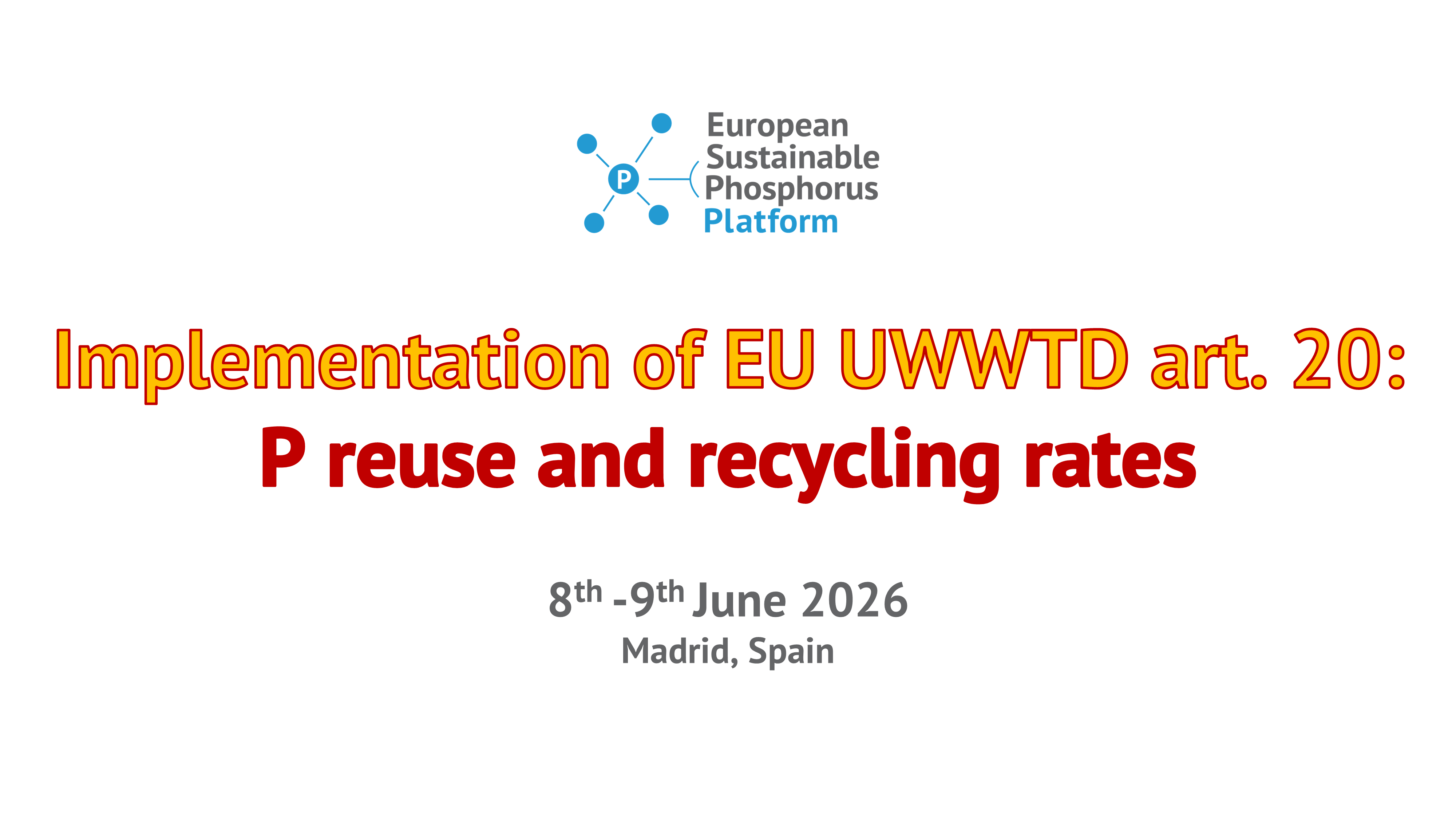 ESPP workshop to input to the development of proposals for phosphorus “reuse and recycling rates” from sewage, update on phosphorus recovery technologies, discussion of quotas (recycled phosphorus content obligations) for fertilisers
This workshop will enable direct dialogue with the European Commission Joint Research Centre (JRC) team working on defining the implementing criteria for the revised Urban Waste Water Treatment Directive art. 20 phosphorus “reuse and recycling rates”.
Workshop on phosphorus reuse and recycling from urban wastewater, Madrid, Monday 8th June 14h00 – Tuesday 9th June 12h30. Site visit to EDAR SUR wastewater treatment plant confirmed on Monday 8th morning (if interested, contact
6th European Sustainable Phosphorus Conference ESPC6 24-25 November, Benguerir, Morocco
 www.phosphorusplatform.eu/ESPC6
ESPC is the world’s leading sustainable phosphorus event, every 2-3 years. Don’t miss it! ESPC6 will include a site visit to an OCP phosphate mine, rock beneficiation and processing.
ESPC6 is co-organised by OCP Group and ESPP, with support of UM6P (Université Mohammed VI Polytechnique).
ESPC6 will take place at UM6P Université Mohammed VI Polytechnique, in Benguerir, 1 hour shuttle from Marrakech, with accommodation in Benguerir or Marrakech.
ESPC6 Tuesday 24 & Wednesday 25 November 2026 www.phosphorusplatform.eu/ESPC6
Thursday 26th November, optional site visits (OCP phosphate rock mine near Benguerir, laboratory and agronomy research at UM6P), limited number of places, book now.
Young Nutrient Researchers Days and/ Early Career Researchers’ Event 21 – 23 November – information coming soon.
A few speaker slots remain: deadline for abstracts extended to 31st May.
Possibilities for posters or stands remain open.
Members of ESPP and of national Nutrient Platforms are invited to present a short “success story” pitch in the conference plenary.
Contact:
Regulatory
EU consultation BioTech II – bio-fertilisers to be included open to 10th June 2026
EU public ‘call for evidence” on proposed BioTech Act II, which aims to develop competitive biotechnology and biomanufacturing in Europe, including for fertilisers. BioTech Act I concerned health biotechnologies. This second proposed BioTech Act aims to address industrial biotechnology and manufacturing, including ensuring sustainable biomass supply across the value chain. Sectors cited include fertilisers, alongside plastics, textiles, construction and plant protection products. BioTech II is cited in the EU Fertiliser Action Plan (19th May, see below). Possible areas of action cited in the Call for Evidence for BioTech II are creating lead markets by market pull measures to create demand “such as setting mandatory minimum content requirements for carbon from bio-based feedstock (biomass, waste)”, defining sustainability criteria, simplification of EU legislation (fertilisers regulations are specifically cited as an example), addressing site permitting and product authorisation bottlenecks, improving investment predictability, and addressing market fragmentation to establish a single market for bio-based products.
ESPP will input to this consultation requesting:
- Relevance of including nutrients and fertilisers in BioTech II, as indicated in the Call for Evidence and in the Fertiliser Action Plan,
- Need to ensure resilient nutrient supply needs to feed crops to input to biomanufacturing, and the related need to recycle nutrients from bio-economy residue streams,
- Importance of recycled nutrients for fertiliser supply resilience, and of inclusion of nutrients in the upcoming EU Circular Economy Act (see below in this eNews),
- Lead market mechanisms should address not only carbon content but also recycled nutrient content,
- Need to enable access of bioeconomy residues to the EU Fertilising Products Regulation, for use as such, after processing, or as inputs to CE-Mark composts and digestates,
- Support of measures proposed in the Call for Evidence for investment predictability, single market for secondary nutrients and bio-based fertilisers, facilitate permitting for industrial sites moving to replace virgin material inputs by secondary materials,
- Develop CEN standard to define bio-based and recycled nutrient contents of fertilisers and other products.
“Food and feed safety – simplification omnibus”, EU public consultation open to 12thJune 2026, https://ec.europa.eu/info/law/better-regulation/have-your-say/initiatives/17394-Biotech-Act-II_en (scroll down to the currently open consultation).
EU consultation on food and feed regulations ‘Omnibus’ open to 12th June 2026
Final consultation on animal feed and food regulation simplification. Proposal fails to address obstacles to P- recycling in the Animal Feed Regulation, moves towards reclassification of most Cat.1 Animal By-Products (ABP). Input to this public consultation will feed into the European Parliament and Council discussion of the Commission’s proposed ‘Feed and Food Omnibus’.
ESPP regrets that despite input from Sweden (ESPP eNews n°100), from eight European organisations led by FEFAC (joint industry proposals, eNews n°97) and from ESPP (eNews n°101), the proposal does not address the annex of 767/2009 which currently excludes from use in animal feed any product extracted from sewage or manure, so excluding processes which generate safe, purified mineral phosphates from incineration ashes.
ESPP also asks that, beyond the proposed omnibus simplifications, the ABP and TSE regulations should be fully reviewed in the context of the 2026 Circular Economy Act, to identify how nutrient recycling can be facilitated whilst ensuring safety and consumer confidence.
“Food and feed safety – simplification omnibus”, EU public consultation open to 12thJune 2026, https://ec.europa.eu/info/law/better-regulation/have-your-say/initiatives/14824-Food-and-feed-safety-simplification-omnibus_en (scroll down to the currently open consultation).
EU consultation for an ‘EU Ocean Act’ open to 16th July 2026
Public questionnaire consultation and call for evidence to revise the Maritime Spatial Planning Directive 2014/89 and to prepare a future EU ‘Ocean Act’. The public and stakeholder questionnaires address general questions, such as relative importance of environment or economy, which aspects of administrative cooperation are important, how to better coordinate cooperation and ocean observation systems. Aquaculture is mentioned in the introductory web page, but not in the call for evidence nor the questionnaire. Eutrophication, phosphorus and nutrients are not mentioned.
“Revision of the Maritime Spatial Planning Directive/the Ocean Act”, EU public consultation open to 16th July 2026., https://ec.europa.eu/info/law/better-regulation/have-your-say/initiatives/16238-European-Ocean-Act_en (scroll down to the currently open consultation).
Towards the end of Cat1 ABP ash
The proposed ‘Omnibus’ changes to different regulations make the first steps towards reclassifying most current Cat.1 ABP materials, which would remove the current requirement to separate and incinerate these materials. The change is justified because current BSE* risk limitation measures in the TSE* Regulation 999/2001 are considered outdated given the near-zero occurrence rates in the EU today. The proposed Omnibus also removes the current ban on use in animal feeds of collagen and gelatine from ruminant bones and would also allow the Commission to modify annexes of 999/2001 to reclassify Cat.1 materials. To what extent the Commission will do this will probably depend on the outcomes of the requested EFSA Opinions on Cat.1 materials (see below). If reclassification is fully implemented, this would effectively reclassify nearly all current Cat1 ABP in the EU from farms (fallen stock) to Cat.2 and that from slaughterhouses to human food or to Cat.3. This would allow, under appropriate conditions, recycling of nutrients including phosphorus mostly to PAP (Processed Animal proteins of cat.3), to petfood and to fertilisers. Currently Cat.1 ash in the EU (estimated by ESPP to contain c. 30 000 tP/y of phosphorus) goes to landfill or cement, with loss of the phosphorus.
The European Commission has mandated EFSA (European Food Safety Agency) to assess whether current BSE monitoring is appropriate and to assess whether it is risk-justified to continue separating and incinerating (most) Category 1 ABP material – see ESPP eNews n°100. Current EU requirements for both monitoring and material separation are stricter than those of the WOAH (World Organisation for Animal Health) Terrestrial Animal Health Code (here). EFSA has delivered the first of these two requested Opinions, concluding that BSE surveillance can be safely reduced but not fully down to the WOAH requirements (BSE testing only of animals with symptoms). Currently the EU requires BSE testing of all bovines slaughtered for human consumption aged ≥30 months and all fallen stock (slaughtered or dead for other reasons ≥24 months). EFSA suggests to retain testing of fallen stock over 60 and emergency slaughtered stock over 72, in order to ensure data on ‘atypical BSE’ and detect any recurrence of BSE.
* BSE = mad cow disease = bovine spongiform encephalopathy - prion transmission / TSE = transmissible spongiform encephalopathy
EFSA Opinion “Possible alignment of the EU BSE surveillance with the new WOAH provisions”, 18 March 2026, EFSA Journal. 2026;24:e10044, https://doi.org/10.2903/j.efsa.2026.10044
European Commission mandate to EFSA, underway: “Request for a scientific opinion on the potential BSE risk of aligning the EU requirements for Specified Risk Material (SRM) removal with the revised WOAH Code Chapter 11.4“ https://open.efsa.europa.eu/questions/EFSA-Q-2025-00442
EU Critical Chemicals Alliance survey on chemical industry investment
Survey aims to identify specific regulations and policy mechanisms that either catalyse or hinder investment in the chemicals industry in Europe, policies which increase investment risk for projects, case studies. These insights will enable the EU Critical Chemicals Alliance (see ESPP eNews n°106) to draft a Charter for practical, investment-relevant solutions that move beyond standard practice.
All companies and concerned organisations are invited to respond to the survey: https://ec.europa.eu/eusurvey/runner/Regulatory_hurdles_for_modernisation_investments_and_innovation
ESPP input on Environmental Simplification
ESPP input to the EU consultation underling the need to maintain and pursue the objectives of the EU Green Deal to achieve both environmental and economic sustainability objectives. ESPP expressed support for administrative simplification where this does not reduce environmental standards.
ESPP suggested that the omnibus package should include eight regulatory changes which would simplify recycling of waste nutrient materials covering Green Listing of relevant nutrient wastes, IED operating permits, waste use in recycling pilot trials, EU Fertilising Products Regulation, End-of-Waste status, coherence of regulatory authorisations for food, feed and fertilisers, REACH.
Concerning the specific proposals in the Commission’s proposed omnibus Regulation text, ESPP supported the proposed exclusion of Certified Organic livestock production from IED requirements (Industrial Emissions and Livestock Rearing Directive), to avoid double regulation. Organic farms are already subject to environmental reporting in Organic Certification. ESPP opposed the proposed exemption from reporting on water, energy and materials for livestock & aquaculture under IED to because this would retard development of efficiency and recycling, leaving EU agriculture dependent on imports and exposed to price fluctuations.
EU public consultation closed 7th May 2026 “Simplification of administrative burdens in environmental legislation”, draft amendments to Regulations https://ec.europa.eu/info/law/better-regulation/have-your-say/initiatives/14794-Simplification-of-administrative-burdens-in-environmental-legislation-_en
See ESPP eNews n°106. “ESPP input Environmental Simplification consultation 7_5_26” www.phosphorusplatform.eu/regulatory
Call to uphold EPR for pharmaceuticals, cosmetics under the revised UWWT Directive
Water industries and farmers have called on the EU to maintain and implement EPR (Extended Producer Responsibility) whereby pharmaceutical and cosmetics industry will pay the costs of sewage micropollutant removal (“quaternary treatment”), as required for certain sewage works under the revised Urban Waste Water Treatment Directive (UWWTD 2024/3019)
EU farmers’ and cooperatives federation Copa-Cogeca, the European Organic Farming federation IFOAM, and water industry and public water operators’ organisations (Eureau, AquaPublica), with the European Environmental Bureau other concerned organisations including environmental NGOs, underline that non-polluted water is essential for agriculture and that the revised UWWTD ensures fair distribution of costs for the new ‘quaternary treatment’ obligations between the micropollutant industries (80%) and water users (20%). The most recent of these letters (AquaPublica and others, April 2026) provides more detailed arguments, noting in particular that the UWWTD states that EPR should apply to all pharmaceuticals and cosmetics placed on the EU market (so to imports as well as EU production), that it allows adjustments to mitigate impacts on generic pharmaceuticals, provides a mechanism to incite development of more environmentally-friendly products, and enables Member States to add other product sectors releasing micro-pollutants to their national EPR scheme (beyond pharmaceuticals and cosmetics).
“Safeguarding the EPR scheme in the recast Urban Wastewater Treatment Directive”:
European Environmental Bureau and others, 6th May 2025, https://eeb.org/wp-content/uploads/2025/05/Joint-letter-to-President-von-der-Leyen.pdf
European Construction Industry Federation (FIEC) and others 13th October 2025 https://www.fiec.eu/news/news-2025/eureau-and-fiec-jointly-call-eu-commission-uphold-epr-scheme-uwwtd
Eurea, Copa-Cogeca, IFOAM, letter to the European Commission, 20th November 2025 https://www.eureau.org/news/995-safeguarding-europes-water-future-defending-the-epr-scheme-in-the-recast-uwwtd
AquaPublica Europea and others, 10th April 2026 https://www.aquapublica.eu/sites/default/files/article/file/EPR%20in%20the%20UWWTD_Call%20on%20MEPs%20to%20support%20implementation.final_.pdf
Circular Economy
Call to include nutrients in the EU Circular Economy Act (CEA) – sign now
As below, there are mixed signals as to whether or not the CEA will address nutrients and biological origin material. At the political level, inclusion of phosphorus in the Circular Economy Act (CEA) seems confirmed. But at the technical level (draft impact assessment study) it seems that only technical materials (plastics, demolition wastes, textiles …) are being considered, not circularity of organic-containing materials from biological processes, organic wastes or the bioeconomy, so excluding most secondary nutrients. Policy measures designed for recycling technical materials may not be suitable for organic-containing wastes which pose specific challenges of food chain safety and confidence. The Joint Call asks that the EU Circular Economy Act be “ambitious for nutrients, to forward sustainability, EU job creation and competitivity, and food system resilience” and suggests 20 policy proposals.
The Joint Call has to date been signed by 40+ organisations. If your company/organisation has not already signed the Joint Call, please contact us before 10th June to be included.
“Joint call for EU Circular Economy Act (6_11_2025)” www.phosphorusplatform.eu/regulatory
Input to the EU Circular Economy Act
ESPP input to the Impact Assessment of the future EU Circular Economy Act underlines the that the Act address nutrients and the bioeconomy (not only technical materials), makes proposals for facilitating waste-to-recycling.
ESPP followed the 30th April workshop organised by the European Commission (DG GROW) and the consultants carrying out the impact assessment (Norion Denmark). ESPP notes the Commission’s declared objective for the Circular Economy Act, as outlined by as outlined Kerstin Jorna, Director General of DG GROW: to open a single EU market for secondary materials, secondary products and recycling technologies. ESPP supports the proposals presented by Norion:
- facilitate transport and placing on the EU market of both secondary materials intended for recycling, and of recycled materials, including by facilitating mutual recognition of national End-of-Waste and the establishment of a transparent EU database of national End-of-Waste criteria and decisions,
- access to the EU market for secondary materials should be based on verified quality not on origin of input materials,
- incite uptake of recycled products in public purchasing.
ESPP underlines that these proposals are highly relevant for organic and bioeconomy streams and for nutrient recycling and the Circular Economy Act should take into account the adaptations needed for bio-based materials for specific aspects such as health and environmental safety, organic carbon valorisation, organic contaminants, interactions with other regulations.
The Impact Assessment as presented seems to be centring on technical materials such as electronics (WEEE) and demolition wastes. ESPP underlines that the Circular Economy Act should also address organic secondary materials, in particular biowastes, digestates and recycled nutrients.
ESPP underlines the importance of the Critical Raw Material ‘Phosphate Rock’. Without phosphate rock inputs, agriculture could probably feed only around 1/5th of the world population (adapted from Dawson et al., Food Policy 2011). Without mineral nitrogen fertilisers (today reliant on natural gas, and today facing a global supply crisis: Ukraine, Hormuz), agriculture could maybe feed half the world population (Smil 2004, Erisman 2008). The EU is today 95% + dependent on imports for these two vital nutrients, and 20% of phosphate fertilisers used in Europe are still today coming from Russia (EU DG AGRI). Nutrient recycling, alongside improving nutrient use efficiency, is thus essential for EU sustainability and sovereignty.
ESPP’s five-page input (13th May 2025) makes a number of targeted proposals for regulatory or policy changes to include into the Circular Economy Act to facilitate nutrient recycling. The Circular Economy Act is work underway and ESPP will be making further input in coming months, so your comments on these proposals are very welcome.
“ESPP input Circular Economy Act Impact Assessment 13_5_26”
Joint call for an EU Circular Economy Act, signed by 40+ industry organisations, companies and stakeholders
“Joint call for EU Circular Economy Act (6_11_2025)”
“ESPP detailed input to EU consultation on Circular Economy Act 2_11_25”
All at www.phosphorusplatform.eu/regulatory
Phosphorus should be part of the EU Circular Economy Act (CEA)
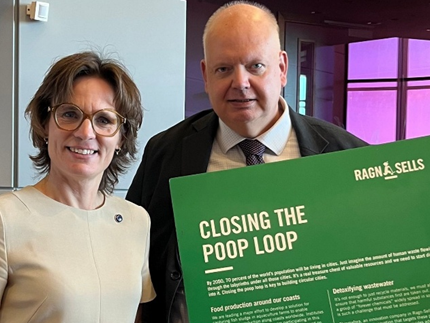 Ragn Sells (ESPP member) participated in a high-level meeting with stakeholders and the European Commissioners on the Circular Economy Act, 30th April. Discussions concluded that phosphorus should be included in this Act. This meeting with industry Commissioner Stéphane Séjourné and environment Commissioner Jessika Roswall preceded the impact assessment workshop summarised above. Pär Larshans, for Ragn Sells, underlined that the EU’s agriculture and food production is around 90% dependent on imported phosphates, today still including from Russia, whereas secondary nutrients are not being recycled because of regulatory obstacles. He particularly noted the unjustified exclusion of purified recycled phosphates in the Animal Feed Regulations, and the EU-level exclusion of aquaculture from recycling to fertiliser by the Animal By-Products and Fertilising Products Regulations.
The EU Commissioner Jessika Roswall, furthered this message “Significant amounts of phosphorus, a vital component in fertiliser, can be recovered from wastewater, reducing our need to import it from other countries”, 4th May, at IFAT, German.
Ragn Sells also has the support of the Sweden Government for phosphorus recycling. On May 11th, vising to the company in Uppsala, Jessica Rosencrantz, Sweden’s Minister for Europe, confirmed that Sweden is asking the European Commission to modify the Animal Feed Regulation to remove the current blockage of recovered phosphates.
Photo: Pär Larshans, Chief Sustainability Officer, Ragn-Sells Group, presents a press release on EU phosphate imports from Russia to Jessika Roswall, European Commissioner for Environment, Water Resilience and a Competitive Circular Economy, Brussels, 30th April 2026.
Interview of Jessica Rosencranz, Sweden’s Minister for Europe https://www.youtube.com/watch?v=YNHB8QenGyI and Ragn Sells press release 11th May 2026 https://newsroom.ragnsells.com/posts/news/eu-minister-at-ragn-sells-the-eu-must-allow-r
Economics of circular economy policies
Theoretical overview study, based on metals and plastics, suggests that EU Circular Economy policies can achieve absolute decoupling of materials consumption from growth, if Border Adjustment mechanisms prevent ‘leakage’. Climate mitigation policies have limited impacts towards promoting circularity. The analysis concludes that both supply and demand policies are needed to support circularity: tax/subsidies and consumption, design and product lifetime changes. ESPP notes that the latter are not applicable to nutrients. Overall economic cost of both policies (in these sectors) would be <1% of GDP and impacts should be mitigated by using revenues from Circular Economy tax measures to reduce taxes on employment. Tax policies considered are a 20 – 30% tax on extraction or use of primary materials (metals, plastics) and subsidies to recycling. Policies are considered necessary to prevent ‘leakage’ (export of EU resources consumption to countries outside Europe), otherwise, primary materials consumed to supply consumption in Europe would increase +5% in the next ten years despite EU Circular Economy policies because of growth. A Border Adjustment Tax on primary materials embedded in imports into the EU is thus considered necessary.
“Circular economy transition in Europe requires ambitious policies beyond climate mitigation”, M. Cepelieve et al., Resources, Conservation & Recycling 225 (2026) 108591, https://doi.org/10.1016/j.resconrec.2025.108591
Fertilisers
EU Fertiliser Action Plan
European Commission ‘Action Plan’ aims to ensure “availability, affordability and strategic autonomy in home-grown EU fertilisers”. Farmers will receive cash aid and with support for nutrient efficiency and for use of recycled fertilisers.
This high-level Commission Communication, comes in response to the current fertiliser supply and price crisis caused by the Middle East crisis adding to Russia’s war of aggression against Ukraine. The plan was launched by Ursula von der Leyen, European Commission President, Raffaele Fitto, Vice-President for Cohesion and Reforms and Christophe Hansen, Commissioner for Agriculture and Food, does not directly include regulatory measures but sets out policy directions and future proposed regulatory changes.
The Action Plan opens by underling that nitrogen and phosphorus fertilisers are essential to agricultural production and food security. It underlines the EU’s import dependency for phosphate rock and on natural gas (for nitrogen fertilisers) and the need to invest in green ammonia and to develop “a wider use of organic, bio-based fertilisers and alternatives to traditional mineral products. Other pathways include algae biomass, other soil enhancers, microbial solutions, biostimulants, and recovery of nitrogen and phosphorus from the sewage sludge”. Obstacles to bio-based fertilisers are noted “including lengthy approval processes, regulatory bottlenecks linked to waste-derived inputs”. The absence of a single market for fertilisers in the EU, with ‘optional harmonisation’ (parallel EU FPR and National fertilisers regulations) is identified as leading to a fragmented marked and lack of standardisation for bio-based fertilisers.
The Plan indicates that “The Commission will support the development and uptake of organic fertilisers and alternatives to conventional inorganic fertilisers, in particular bio-based fertilisers, through nutrient recycling, phosphorus and nitrogen recovery, biomethane and biogas pathways, digestate valorisation, valorisation of algae biomass, microbial solutions and other innovative technologies … facilitating the production and safe use of recovered nutrients, and to valorise residues, waste, byproducts across value chains including agriculture, forestry, aquaculture and fisheries”. Cited actions include fixing a “clear definition” for bio-based fertilisers (see ESPP proposals document on “definitions” at www.phosphorusplatform.eu/regulatory and ESPP eNews n°73).
The Plan indicates that a Common Agricultural Policy (CAP) package will include financial aid for farmers, funding routes to “improve fertilisation efficiency, stimulate sustainable use of recycled nutrients” and that CAP cohesion funds should include funding for nutrient recovery from municipal wastewater and from anaerobic digestion and investments for on-farm nutrient recycling, as well as possible use of ETS (Emissions Trading Scheme) revenues to support recycled fertilisers.
It is indicated that the Commission will assess the need to set “nutrient recycling targets … for organic waste streams, including wastewater and sludge of industrial and urban origin, biowaste, digestate and other waste”. ESPP notes that this is already underway for municipal wastewater under art. 20 of the revised Urban Waste Water Treatment Directive 2024/3019.
It notes synergy with other EU policies such as creating lead markets for bio-based fertilising products in the (future) BioTech Act II, the BioEconomy Strategy, the revised Urban Waste Water Treatment Directive, AccelerateEU 2026 (Energy Union – Affordable and Secure Energy through Accelerated Action, COM 2026(370)), which states that by summer 2026 “The Commission will map European capacities to complement oil and gas as feedstocks for chemicals, ceramics, glass, plastics and fertilisers with circular and bio-based materials and will work with industry to identify and address barriers to their deployment in the short term”.
The Annex to the Action Plan lists 25 Key Actions which the European Commission proposes to engage or assess, including
- targeted financial support to the most affected farmers, through existing and possible new Common Agricultural Policy (CAP) fund mechanisms [Action 1]
- CAP support for fertilisation efficiency [Action 1], for a nutrient efficiency transition scheme [Action 16]
- possible trade policy actions to facilitate fertiliser import, whilst considering domestic producers [Action 6]
- facilitate “use of digestates” as fertilisers by widening the RENURE 2026/288 Nitrates Directive exemptions. At present, this only covers struvite, ammonia scrubbing salts and reverse osmosis concentrates from manure, under complex conditions (see ESPP eNews n°106). [Action 2]
- Amend the EU Fertilising Products Regulation and review ‘Mutual Recognition’ to create fully integrated markets and develop lead markets [Actions 10, 11]
- Quotas (blending requirements) for “bio-based (organic) and low carbon” fertilising products [Action 11]
- Address regulatory bottlenecks in the Waste Framework Directive, the Fertilising Products Regulation and the Animal By-Products Regulation by including nutrients in the (future) EU Circular Economy Act [Action 11]
- Support further work on a ‘combined minimum reuse and recycling rate” for phosphorus from sewage (as indicated above, already underway for municipal wastewater under art. 20 of the revised Urban Waste Water Treatment Directive 2024/3019) and consider extending this to nitrogen [Action 13]
- Reinforce research, innovation and scale-up for bio-based fertilisers and green ammonia [Action 14]
- Promote nutrient use efficiency and bio-based fertilisers in carbon farming certification [Action 18]
- Promote transfer of nutrients from regions with surpluses to regions with nutrient needs, via the EU Livestock Strategy [Action 20]
“Commission presents plan to secure Europe's fertiliser supply and food security”, European Commission press release 19th May 2026. NOTE: this enables access to the ‘Action Plan’ text (19 pages) but NOT to the important Annex which lists 25 Key Actions.
Action Plan (19 pages) COM (2026)310 and Annex (list of 25 actions, via DG AGRI page “Ensuring availability and affordability of fertilisers” https://agriculture.ec.europa.eu/common-agricultural-policy/agri-food-supply-chain/ensuring-availability-and-affordability-fertilisers_en#fertiliser-action-plan
Contaminants in ash, phosphorus recycling and EU and German regulations
Stakeholders have suggested it is forbidden to combine sewage sludge incineration ash (SSIA) with other materials to achieve fertiliser contaminant limits. ESPP understands that this is true in Germany, but not at the EU level.
The EU Waste Framework Directive 2008/98 (consolidated 16/10/2025) bans, only for hazardous waste, mixing or dilution in order to reduce contaminants to a level where it is no longer defined as hazardous (art. 7.4 and art. 18). In practice, this means that there is no EU regulatory obstacle to processes which react sewage sludge incineration ash with other chemicals (e.g. phosphoric acid) and so reduce concentrations of contaminants (certain heavy metals) to levels below limits for use in fertilisers. Such processes generally have also the objective of improving the plant availability of the phosphorus in the ash (acidulation). Such processes are indeed authorised, under specified conditions, in the EU Fertilising Products Regulation (CMC13, PFC1C “inorganic” fertilisers, plus Annex III, part IIU, 1-4(b) for “mineral” fertilisers).
ESPP understands that for most wastes, the German Circular Economy Law (KrWG) prevents diluting only of hazardous wastes (section 9A-1: “Vermischungsverbot und Behandlung gefährlicher Abfälle“), conform to the EU Waste Framework Directive.
However, the German fertilisers ordonnance (Düngemittelverordnung - DüMV) states “§3 Approval of fertiliser types: fertilisers may … only … on the condition that … 3. in fertilisers … as well as in the starting materials [“Ausgangsstoffen”] for these fertilisers … the limit values set out in Annex 2, Table 1.4, Column 4 are not exceeded. This table fixes the following limits:
-
- Arsenic 40 mg/kg
- Lead 150 mg/kg
- Cadmium 5 mg/kg or 50 mg/kg-P2O5
- ChromiumVI 2 mg/kg
- Nickel 80 mg/kg
- Mercury 1 mg/kg
- Thallium 1 mg/kg
- PFOA+PFAS 1 mg/kg
- Dioxins etc 30 ng/kg WHO-TEQ2025
Because these limits apply to the input material, and because much SSIA will fail one of these criteria, this appears to mean that no material processed from SSIA can be used as fertiliser under the German fertilisers regulation, irrespective of whether this is via production of phosphoric acid and purification to remove contaminants, combination with rock-derived phosphoric acid to dilute relevant contaminants, … ESPP notes that this appears to mean that no phosphate fertiliser produced from phosphate rock with cadmium content > 50 mgCd/kg-P2O5 can be sold under the German fertilisers ordinance.
It should be noted that if a product is CE-Marked under the EU Fertilising Products Regulation it can be sold in Germany as an EU-fertiliser, irrespectively or whether or not it respects the German fertiliser ordinance.
German fertilisers ordinance “erordnung über das Inverkehrbringen von Düngemitteln, Bodenhilfsstoffen, Kultursubstraten und Pflanzenhilfsmitteln1 (Düngemittelverordnung - DüMV)” https://www.gesetze-im-internet.de/d_mv_2012/BJNR248200012.html
Reader input on similar barriers to recycling of waste to fertiliser in other EU Member States, or on the legality of diluting contaminants to achieve fertiliser limits, are welcome.
French government health agency calls to reduce fertiliser cadmium levels
France’s National Health Safety Agency (ANSES) says the population is overexposed to cadmium, mostly coming from food, and calls to reduce cadmium limits in mineral (20 mgCd/kgP2O5) and organic fertilisers (1 mgCd/kgDM). ANSES already recommended these levels in a previous expertise report published in 2019. The ANSES report published in February 2026 coincides with the currently ongoing official Evaluation of the EU Fertilising Products Regulation (FPR) which requires the European Commission to review limit values for phosphate fertilisers and to assess the feasibility of reducing these. The February 2026 ANSES expertise report updates the 2019 report, in particular in consideration of 2021 data on levels of cadmium in the human population which suggests that nearly 50% of the adult population in France is overexposed to cadmium
This is stated to be based on a “critical” urine cadmium level of 0.5 µgCd/g-creatinine, referenced to Oleko 2021. This is surprising, because Oleko does not propose this number, but refers to Fréry 2011 (based on ENNS 2006-2007) which proposed as “reference values” 0.5 µg/g-creatinine for adults < 40 years and higher numbers for older adults, and noted that Germany has a reference value of 0.8 for all adult non-smokers.
ANSES notes that up to 98% of cadmium intake (for non-smokers) today comes from food, in particular from cereals because these are frequently eaten, as well as potatoes and some legumes.
The FPR at present limits cadmium to 60 mgCd/kgP2O5 or 1.5 – 3 mgCd/kgDM in inorganic, organic and organo-mineral fertilisers, soil improvers, liming materials and growing media. Under the FPR, fertilisers with <20 mgCd/kgP2O5 can be labelled “Low Cadmium”. ANSES notes that fertilisers sold in France are not obliged to respect the FPR limits, because fertilisers can also be sold under national fertilisers regulations, and France’s fertilisers regulation sets a limit of 90 mgCd/kgP2O5. ESPP notes that this is probably not pertinent in that >95% of inorganic fertilisers sold in Europe today are estimated to use the FPR and not national rules (compared to <5% for organic and organo-mineral fertilisers) (1).
In addition to recommending to reduce cadmium limits in mineral fertilisers to 20 mgCd/kgP2O5 and in organic fertilisers to 1 mgCd/kgDM, ANSES recommends to promote farming practices such as adjusting fertiliser application to the soil and the crop, development of crop varieties with lower tendency to uptake cadmium, and that consumers reduce consumption of sweet cereal-based products (breakfast cereals, biscuits, cakes) and replace cereal-based foods such as pasta with legumes.
(1) Background Working Paper for the first Stakeholder Workshop on the Evaluation of the FPR, 15th October 2025, CSES, CSIL and Prospero (not published).
ANSES France “Cadmium : agir dès à présent à la source de la contamination des sols”, (cadmium; act now at the source of soil contamination”, 25th March 2026 https://www.anses.fr/fr/content/cadmium-agir-des-present-la-source-de-la-contamination-des-sols and expertise report (390 ages) “Le cadmium. Priorisation des leviers d’action pour réduire l’imprégnation de la population française selon une approche d’exposition agrégé. Connaître, évaluer, protéger” (cadmium: prioritisation of levers for action to reduce presence of cadmium in the French population using an aggregated exposure approach”, February 2026 https://www.anses.fr/system/files/ERCA-2023-AUTO-0150-RA.pdf
EU Fertilising Products Regulation (FPR)
ESPP input to consultations on the third version of the NMI report on authorising additional materials and processes in the FPR, on proposals to add certain Animal By-Products and on the draft consultants’ report for the FPR Evaluation.
CSES report for the official Evaluation of the FPR
The FPR art. 49 requires that (by July 2026) the European Commission submit to Parliament and Council a report assessing the application and impact of the FPR, the attainment of its objectives, interactions with National fertilisers regulations, a review of cadmium, uranium and other contaminant limits. The first draft of the consultants’ (CSES) report (350 pages) was received 21st April for presentation at an online workshop 24th April with deadline for comments 8th May.
ESPP input notes that the report confirms that the FPR is failing to enable nutrient circularity, with a majority of consulted stakeholders not seeing progress in circularity and only 1-3 % of relevant products sold in the EU today being CE-Mark (c.f. organic and organo-mineral fertilisers). See ESPP eNews n°101. The report shows that stakeholders consider that this is because relevant secondary nutrient materials are still excluded from the FPR and the FPR is not flexible to innovation and technical progress (see below, NMI report), complexity, CE-Mark compliance cost.
ESPP input does not repeat our detailed comments already submitted to the public consultation launching the Evaluation (“ESPP input FPR evaluation 19_9_2025” and ESPP eNews n°100.) but notes what we see as important questions which should be more fully addressed in the Evaluation report:
- Take into account the developing bioeconomy. The draft report refers only twice to the bioeconomy, indicating links between the FPR and EU BioEconomy Strategy, but without analysis,
- Need for a criteria-based approach to respond to innovation in recycling. A proposal is currently being developed by a Joint Task Force bringing together the industry federations concerned by different types of fertilising products, with work on a first draft led by ECOFI and ESPP.
See joint position of nine organisations “Addressing structural barriers to innovation, circularity, and market access in the EU Fertilising Products Regulation (EU) 2019/1009” 10_2_2026 (here phosphorusplatform.eu/regulatory -> Fertilisers). - Possible intermediate approach, between fragmented National fertilisers regulations and EU End-of-Waste, based on traceability, producer responsibility and the EU Digital Product Passport (see below proposals for the EU Circular Economy Act),
- Should FPR art. 42.1 be modified to facilitate inclusion of innovation, nutrient recycling and bioeconomy materials into the FPR ? This would require votes of Parliament and Council, so should be addressed in the Evaluation Report. The current wording requiring “potential … significant on the internal market” effectively excludes low value/weight secondary nutrient materials (unprocessed digestate), locally specific / small volume materials (typical of local bioeconomy), so preventing development of a single market for relevant recycling technologies and know how, and potentially excluding such materials from use is the agri-food industry or supermarkets require CE-Mark in future purchasing criteria.
- Possible alignment of cadmium limits of National fertilisers regulations, which can currently allow cadmium levels higher than those authorised in the FPR.
NMI report on new materials and processes for CMCs
This is now the fourth draft report from NMI on their study for the European Commission, supposed to evaluate whether secondary materials or new processing methods proposed to the EU Survey in 2022 should be authorised as inputs to the EU Fertilising Products Regulation (Annex II CMCs): inception report 5/2024, first report 9/2025, first draft of second report 2/2026, second draft 5/2026. Progress is extremely slow, and around half the materials and processes proposed are rejected, in many cases because of “inadequate data”. This despite in some cases, data developed by publicly-funded R&D projects. See ESPP eNews n°105. NMI has proposed rejection of vivianite, fertilising products recovered from separately collected urine or faeces, sewage sludge biochars, ammonium sulphate and ammonium phosphate from fire extinguisher refilling, but stakeholders consider that evidence provided has not been appropriately considered.
ESPP considers that the NMI study process shows that, despite the European Commission’s efforts, the FPR is at present not designed to adapt timely to innovation in nutrient recycling and the bioeconomy: new materials proposed in 2022 are still under discussion and at best 1-2 years away from inclusion into the Regulation. There is no guidance as to what data and how much data is required to respect art. 42.1 requirements to prove safety, agronomic value and potential trade. A material classed as a “By-Product” by one Member State can be authorised, but if exactly the same material is classed as “Waste” in another Member State it is excluded. Proposed materials are examined one by one, so e.g. if magnesium and zinc recovered from battery recycling are admitted for use in micronutrient fertilisers, copper or phosphate recovered from batteries remain excluded.
ESPP input to the public consultation on the final draft of the Delegated Regulation to include certain Animal By-Products (ABPs / “derived products”) into the EU Products Regulation under CMC 10 (See ESPP eNews n°107). This proposes to authorise use under CMC10 of the following ABPs * :
- “processed” manure and insect frass (processed as per ABP regulations). Processed manure was already authorised by 2024/1682 (see ESPP eNews n°89). Insect frass is added
- Glycerines
- Processed Animal Protein (PAP)
- Meat and Bone Meal
- Blood, horn and hooves products
- Hydrolysed protein (including from leather or textile industries) **
- DCP and TCP
ESPP welcomes the list of ‘post-processing’ processes, which is important and should be extended to all FPR CMCs (otherwise, as soon as an eligible input material is modified, e.g. by drying or granulation, it can cease to be eligible) and the authorisation of additives necessary for such post-processing (but suggests wording should be modified for clarity; suggests to delete storage precautions which are in any case standard industry practice, and notes confusion between ABPs Cat2 and Cat3.
ESPP regrets that wool and hair are still not included, despite this being explicitly referred by Parliament and Council in FPR art. 46. ESPP also regrets that no progress has been made towards including aquaculture sludge (fish manures), whereas other manures are included.
* ABPs are already authorised for use in FPR composts, digestates and ash-derived products, by 2026/1605 and FPR CMCs 3, 5, 13.
* A limit of 400 mg/kgDM TOTAL chromium for these materials will limit the use of leather and textile processing by-products.
Public consultation, closed 11th May 2026, “Products derived from animal by-products as component materials in EU fertilising products” https://ec.europa.eu/info/law/better-regulation/have-your-say/initiatives/16132-Products-derived-from-animal-by-products-as-component-materials-in-EU-fertilising-products_en
“ESPP comments draft FPR Evaluation report 8_5_2026”
“Industry joint statement “Addressing structural barriers to innovation, circularity, and market access in the EU Fertilising Products Regulation” 10_2_2026”
“ESPP input FPR evaluation 19_9_2025”
“ESPP comments NMI reports FPR new materials and new processes 27_4_26 and 20_2_26”
“ESPP input EU consultation ABPs CMC10 FPR 11_5_26”
All online at www.phosphorusplatform.eu/regulatory
Nutrient management
Phosphorus recovery: Haskoning acquires ViviMag® patent
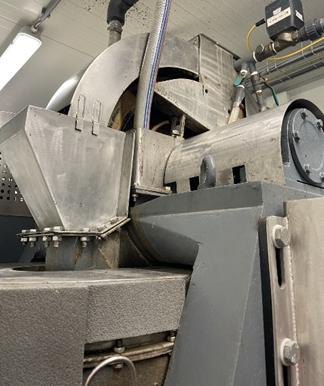 Global consulting engineers, Haskoning, has acquired the ViviMag patent (from Kemira). ViviMag uses a magnetic field to extract vivianite (iron(II) phosphate) from sewage sludge (see SCOPE Newsletter n°156). ViviMag recovers a high percentage of vivianite present in sludge, enabling recovery of around 40 – 60% of sewage works phosphorus inflow as vivianite (iron(II) phosphate) with <1% organics content.
Haskoning has long-standing expertise in phosphorus recovery and circular water solutions. The Crystalactor™ zerowaste crystallisation technology at Geestmerambacht sewage works was the first full-scale P-recovery installation built in Europe (recovering 300 t/y of calcium phosphate pellets) and was already described in the very first edition of the SCOPE newsletter in 1990.
Haskoning is now involved in the design process of the first full scale demonstration ViviMag plant (LIFE-project Phos4EU) with Waterschap Brabantse Delta, a water authority in The Netherlands, with the objective of treating 50% of the digested sewage sludge at the Nieuwveer wastewater treatment plant in Breda (400.000 p.e.), designed to recover 630 t/y of vivianite. The objective is that the recovered vivianite will be sold to the fertiliser industry for agricultural soils where iron-phosphate fertilisers are suitable. In parallel, research will take place at Wetsus to assess the use of vivianite from wastewater as a source for the production of LiFePO4 for cathode materials for LFP batteries.
Haskoning also offers phosphorus removal technologies including Nereda®, an aerobic granular sludge technology (SCOPE n°158 and n°133). The BioPhree® process, owned by Aquacare, is developed in partnership with Haskoning (SCOPE n°158).
Photo existing ViviMag pilot.
“Haskoning acquires patent for groundbreaking ViviMag® water technology”, Haskoning, 14th April 2026 https://www.haskoning.com/en/newsroom/news/2026/haskoning-acquires-patent-for-groundbreaking-vivimag-water-technology
Media focus on aquaculture nutrient pollution
Sunstone Institute science data report says Norway’s aquaculture releases 13 000 t/y phosphorus, 75 000 t/y nitrogen and 36 000 t/y organic carbon into the sea, equivalent to raw sewage from 17 – 30 million people. The Sunstone Institute is a ‘philanthropy-funded’ organisation bringing together data scientists and journalists to communicate on threats to humanity, from monetary systems to climate and environment. The Institute’s 30-page report on Norwegian salmon and trout farming in open-net cages at sea. Norway produces over half of Atlantic Salmon worldwide, with nearly 1 000 farms, but salmon and trout are only 3% of global aquaculture production. The report suggests that the industry faces significant challenges, including over 15% of farmed salmon dying, as well as environmental impacts. The report’s nutrient flow calculations are based on fish feed consumption, fish harvest and fish mortalities. Comparison with human sewage was based on estimates of 1.8 gP, 12 gN and 60 gCorg per person per day. Calculations suggest that Norway’s open sea salmon and trout farms release 13 000 t/y of phosphorus to the sea, that is around 60% of phosphorus input in fish feed. This nutrient loss is equivalent to raw sewage from 20 million people. Media coverage (e.g. The Guardian, UK) relate Norway’s aquaculture nutrient losses to eutrophication and depletion of oxygen levels in fjords.
“Assessing nutrient discharges from Norwegian aquaculture into coastal waters’, Nutrient Analysis Report, Sunstone Institute (37 pages), A. Pires Duro & C. Brown, 5th May 2026 https://sunstone.institute/api/data/report/aquaculture-data-nutrient-analysis-report/download
“Norwegian fish farms polluting fjords with waste likened to ‘raw sewage of millions of people’ “, The Guardian, A. Niranjan, 4th May 2026 https://www.theguardian.com/world/2026/may/04/norwegian-fish-farms-polluting-fjords-with-waste-likened-to-raw-sewage-of-millions-of-people
ESPP Members
Stay informed
SCOPE Newsletter: www.phosphorusplatform.eu/SCOPEnewsletter eNews newsletter: www.phosphorusplatform.eu/eNewshome
If you do not already receive ESPP’s SCOPE Newsletter and eNews (same emailing list), subscribe at www.phosphorusplatform.eu/subscribe
LinkedIn:https://www.linkedin.com/company/phosphorusplatform
Slideshare presentations:https://www.slideshare.net/phosphorusplatform